

Free Claude AI API Credits in 2026: Every Verified Path
Every verified way to get free Claude API credits in October 2026, from the $5 starter balance to startup, research, open-source, and cloud programs worth up to $100K. Current pricing, claim steps, and the mistakes that drain free credits fastest.

Claude's API is pay-as-you-go, but you do not have to pay on day one. As of October 2026 there are seven verified ways to get free Claude API credits, ranging from a $5 starter balance anyone can claim in five minutes to startup and research grants worth five and six figures. This guide lists each one with current amounts and eligibility, shows the exact claim steps, and covers the five mistakes that quietly burn free credits before you ship anything.
One note before we start: this space moves fast. Anthropic launched its Claude for Startups credit bundle on October 6, 2026 and paused it three days later for being over capacity. Every figure below was verified in October 2026; check the linked official page before you plan around a large grant.
Every Verified Free Credit Program (Quick Overview)
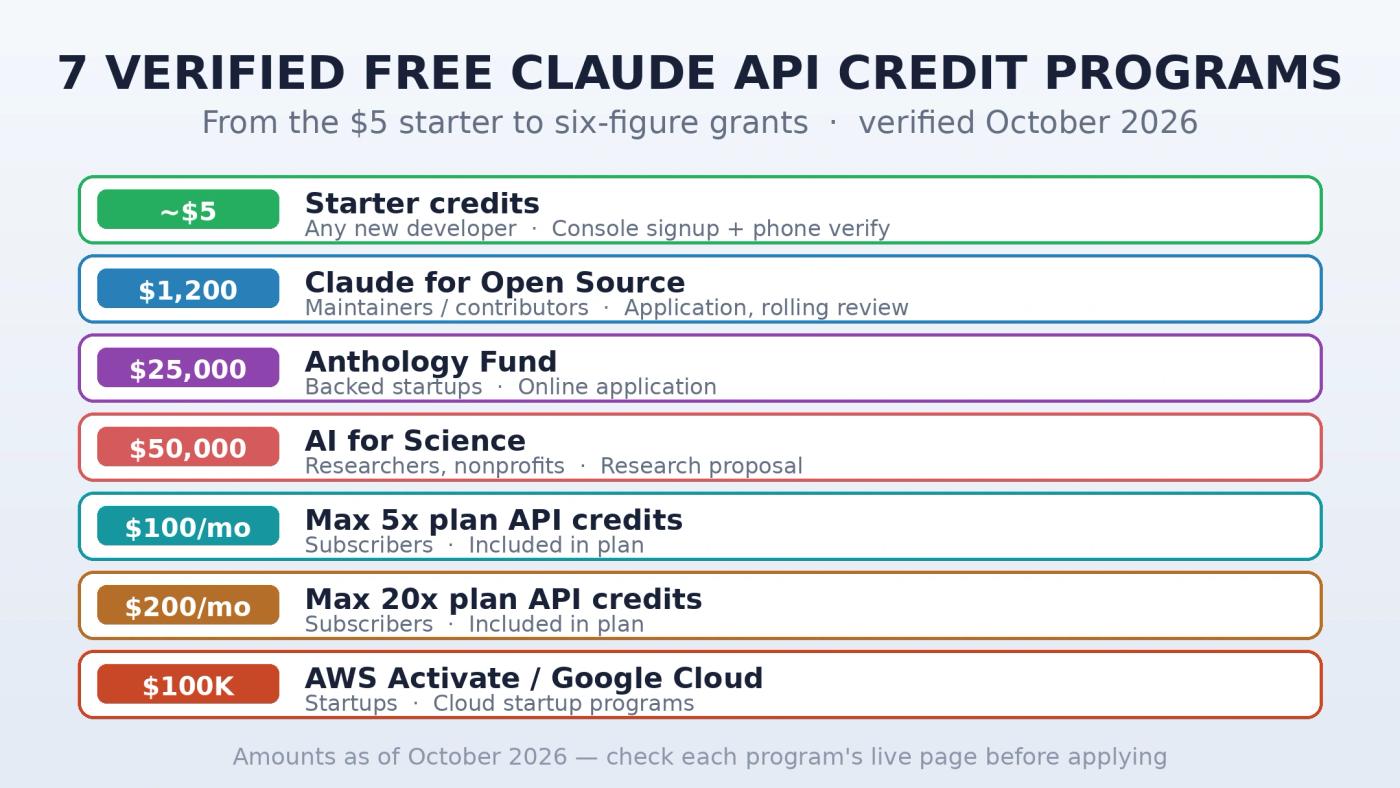
Seven programs currently hand out free Claude API access. They stack in a rough ladder from individual developers to funded startups:
| Program | Credit amount | Who qualifies | How to apply |
|---|---|---|---|
| Starter credits | ~$5 | Any new developer | Console signup, phone verify |
| Claude for Open Source | ~$1,200 (6 months of Max 20x) | Maintainers and contributors | Application, rolling review |
| Anthology Fund | $25,000 | Backed startups | Online application |
| AI for Science | Up to $50,000 | Researchers and nonprofits | Research proposal |
| Max 5x plan | $100/month API credits | Subscribers | Included in plan |
| Max 20x plan | $200/month API credits | Subscribers | Included in plan |
| AWS Activate / Google Cloud | Up to $100,000 | Startups | Cloud startup programs |
A quick reality check on two programs you will see in older guides: Anthropic does not publish a standing "student discount" for the API, and the $1,000 External Researcher Access figure has no current official source. We only list what we could verify.
How to Claim Your $5 Starter Credits (Step by Step)
The fastest path takes under five minutes. Sign up at the Anthropic Developer Console, complete phone verification, and claim the credits in billing.
- Create your account at the Anthropic Developer Console with an email address or Google login.
- Complete SMS phone verification when prompted. This step is mandatory, and some regions face restrictions on accepted number types.
- Open Settings, then Billing and find the free-credit balance shown for your new account.
- Click "Claim." The 14-day expiration clock starts at this moment, not at signup.
- Confirm the balance in the same billing panel. Anthropic does not publish the exact figure officially; developers consistently report roughly $5.
The most common mistake is treating the credits as automatic. They are not. Skip step 4 and the balance just sits there, and every day you delay claiming without a project ready is a day you cannot get back.
How to Create Your First Claude API Key
Once the account exists, generating a key takes less than a minute. The full key shows only once, so store it immediately.
- In the Developer Console, open Settings and select API Keys.
- Click "+ Create Key" and give it a descriptive name, like prototype-haiku.
- Choose the workspace and permissions, then confirm.
- Copy the key right away. It follows the sk-ant-... format and will never appear again.
Two things trip up first-timers: hardcoding the key into scripts instead of using the ANTHROPIC_API_KEY environment variable, and sending it in an Authorization header when the API expects x-api-key. Either one produces silent authentication failures. Anthropic documents the exact headers in its API overview; follow them once and you will never debug this again.
The $25K+ Programs: Anthology Fund, AI for Science, and Open Source
Anthology Fund: $25,000 in Credits for Backed Startups
The Anthology Fund, a $100 million initiative from Anthropic and Menlo Ventures, backs pre-seed, seed, and Series A startups building on Claude. Selected companies receive $25,000 in free API credits plus venture support. Applications run through an online form and are reviewed on a rolling basis.
AI for Science: Up to $50,000 Per Research Project
Anthropic's AI for Science program now offers up to $50,000 in Claude credits per project to academic and nonprofit researchers across all scientific fields, reviewed on a rolling merit basis. The July 2026 rare-disease thematic call added structured cohorts for scientists and early-stage biotechs. This replaced the older $20,000 figure you may still see quoted.
Claude for Open Source: 6 Months of Max 20x
Qualifying maintainers and core contributors get six months of the Max 20x tier, worth about $1,200, through Claude for Open Source. Eligibility runs through several tracks, from package download volume to merged pull requests across the ecosystem, and review is rolling until the 10,000-recipient cap is reached. Older guides list a June 2026 application deadline; the program is still open.
A Note on Claude for Startups
In early October 2026 Anthropic expanded its startup program with a free Claude Team year and $1,000 in API credits, then paused the offer on October 9, 2026 after demand exceeded capacity. Anthropic says it will re-review applications, and founders who already claimed keep their benefits. If you apply now, treat the headline offer as pending rather than promised.
The Cloud Routes: AWS Activate and Google Cloud for Startups
If your team already holds cloud credits, they can become Claude credits. AWS Activate offers Founders $1,000 and Portfolio members up to $100,000 in credits, all spendable on Claude through Amazon Bedrock. Google Cloud for Startups provides cloud credits usable for Claude through Vertex AI, with amounts varying by program tier. For Claude Code users, route requests through Bedrock or Vertex AI with the standard provider environment variables. Our AI automation guide for businesses covers how Claude fits into a larger stack.
One more route most people miss: Max 5x and Max 20x subscriptions now bundle $100 and $200 per month in API credits respectively, per Claude's pricing page. If you already pay for Max, part of your bill is API access you may not be using.
What $5 Actually Buys You (October 2026 Pricing)
Model choice is the biggest lever on a small credit balance, so here is the current rate card:
| Model | Input / 1M tokens | Output / 1M tokens | Best fit |
|---|---|---|---|
| Claude Haiku 5.5 | $0.10* | $0.50* | Prototyping, prompt iteration |
| Claude Sonnet 5.5 | $2 | $10 | Everyday coding and writing |
| Claude Opus 5.5 | $4 | $20 | Hard reasoning, long agent runs |
| Claude Fable 5.1 | $10 | $50 | Flagship-grade reasoning |
*Haiku 5.5 prompts over 100K tokens: $0.50/$2.50. Batch API: 50% off input and output. Prompt caching reads cost about 10% of the base input rate.
Roughly speaking, $5 buys about 50 million input tokens on Haiku 5.5 or 2.5 million on Sonnet 5.5, before output costs. A prototype that runs 200 test calls at 2,000 tokens in and 300 tokens out on Haiku 5.5 costs about fifteen cents. The same prototype on Opus 5.5 costs close to five dollars. Start on Haiku 5.5, move up only when you can name the quality gap, and you will still have budget left for a second iteration. For how Claude compares as a writing tool, see our Claude for SEO guide.
5 Mistakes That Drain Free Credits Fast
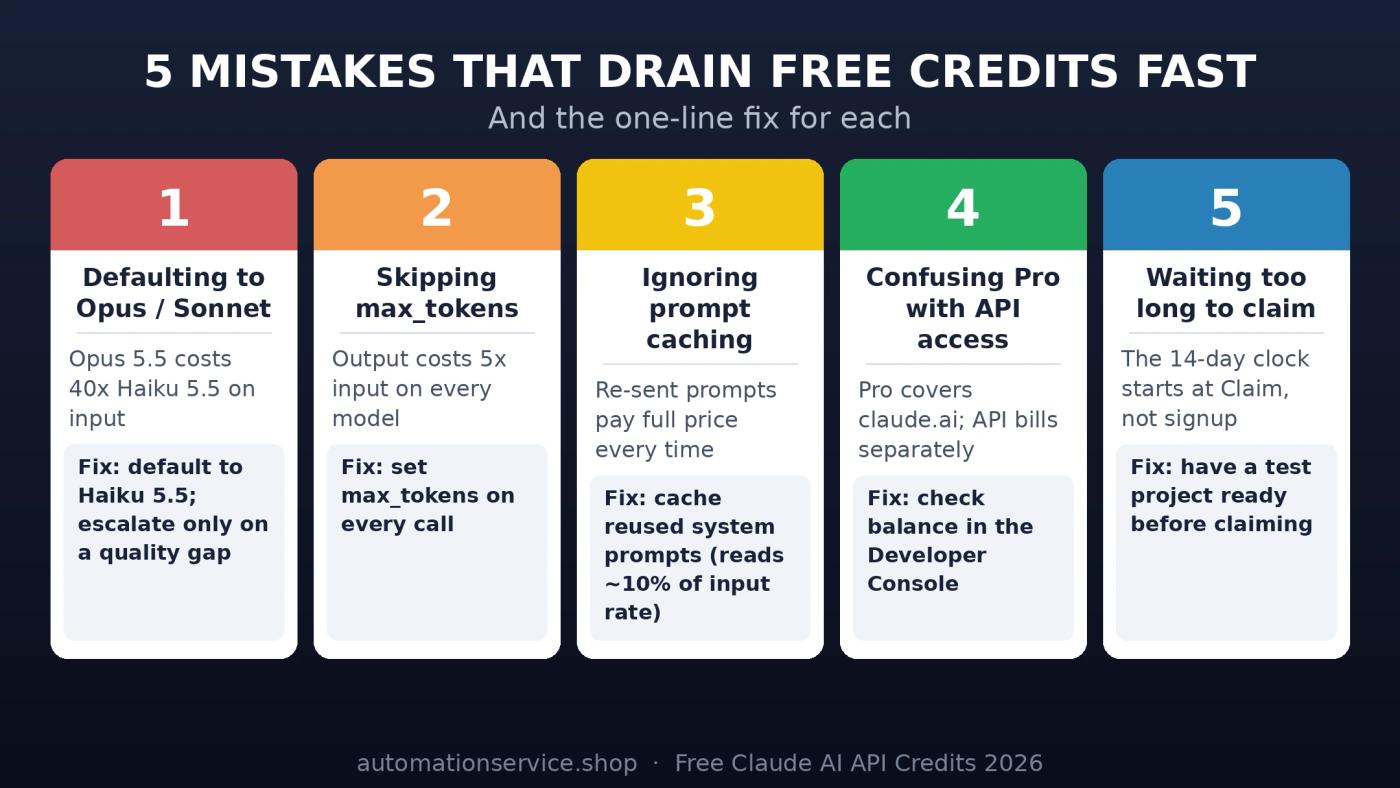
1. Defaulting to Opus or Sonnet for everything. On input pricing, Opus 5.5 costs 40x more than Haiku 5.5. Prototyping on a flagship model burns your whole balance on a demo. Fix: default to Haiku 5.5; escalate to Sonnet 5.5 only for a documented quality gap.
2. Skipping the max_tokens parameter. Output costs 5x input on every model, so uncapped responses are where the money goes. Fix: set max_tokens explicitly in every call, sized to the response you actually need.
3. Ignoring prompt caching. Resending the same system prompt on every call pays full price each time, while cache reads cost about 10% of the base input rate. Fix: enable prompt caching for any system prompt or context block you reuse.
4. Confusing Claude Pro with API access. The $20/month Pro subscription covers the claude.ai web app. API billing is entirely separate with its own balance. Fix: check credits in the Developer Console, not in claude.ai settings.
5. Waiting too long to claim. The 14-day window starts at "Claim," and waiting a week to explore first burns half your time. Fix: have a test project ready before claiming, then build immediately.
Rate Limits on Free Credits: What to Expect
Free-credit accounts sit in the lower usage tiers, and limits bind before dollars do. As of October 2026, Anthropic's rate-limit docs define four tiers: reaching Tier 1 takes $5 in cumulative purchases with a $100 monthly cap and 50 requests per minute, and input/output token-per-minute limits vary by model class. Free starter credits do not count as purchases, so a free-credit account stays at the base tier until you actually deposit funds. Cached tokens do not count toward input limits, so the prompt-caching habit above also raises your effective throughput. New to Claude's free tier outside the API? Our guide to using Claude AI for free covers that side.
Frequently Asked Questions
Is the Claude API free to use?
The API itself is a paid service, but new console accounts get roughly $5 in free credits to start, no credit card required. When the credits run out or expire, 14 days after you click Claim, you add a payment method to continue. Startup, research, open-source, and cloud programs offer much larger free allocations if you qualify.
Do I need a credit card to get Claude API credits?
No. The starter credits need only an email signup and SMS phone verification. A payment method becomes necessary only when you want to add funds beyond the free balance. Note that free credits do not count toward the $5 cumulative purchase that moves your account to Tier 1 rate limits; new deposit tiers require actual purchases.
How long do the free Claude API credits last?
Fourteen days from the moment you click "Claim" in the Developer Console, not from signup. Unclaimed credits sit idle until you activate them, so have your first test project ready before claiming. Nothing extends the window, so use the time for a focused prototype rather than open-ended exploring.
What is the cheapest Claude model for API testing?
Claude Haiku 5.5, by a wide margin: $0.10 per million input tokens and $0.50 per million output tokens for prompts under 100K tokens. That is 20x cheaper than Sonnet 5.5 on input and 40x cheaper than Opus 5.5. Haiku 5.5 handles classification, extraction, prompt iteration, and prototype testing well; switch to Sonnet 5.5 only when you can point to a quality gap in Haiku's output.
Can students get free Claude API credits?
There is no standing Anthropic student discount for the API as of October 2026. Students get the same $5 starter as everyone else. The realistic student routes are: university-affiliated AWS or Google Cloud education credits spent on Claude via Bedrock or Vertex AI, and Claude for Education if your school bought the plan. For study workflows, our best AI study tools for students lists what is actually free right now.
Can I use AWS or Google Cloud credits to access Claude?
Yes. AWS Activate credits apply to Claude through Amazon Bedrock, and Google Cloud for Startups credits cover Claude through Vertex AI. Both routes use your cloud credits instead of Anthropic billing, which matters if your startup or research lab already sits on a cloud grant.
Are "free Claude API key" websites safe?
No. Sites that hand out free API keys distribute shared or leaked credentials. Using them exposes your prompts and data to whoever controls the key, and Anthropic revokes compromised keys without warning. Generate your own key in the Developer Console; it takes under a minute and costs nothing.
Start With the $5 Everyone Can Claim
Free Claude API access has a clear ladder. Start with the $5 starter balance for your prototype, pick the program tier that matches who you are, developer, student, researcher, maintainer, or founder, and apply before you need the credits, not after. If a grant program is your target, check its live page first: amounts and windows change, and this guide's figures were current as of October 2026.
Not calling the API at all? You can still chat with the flagship models: our tested setup for Claude 5.5 and GPT-6 free via Puter runs them in the browser on a free Puter allowance, instead of credits you claim here. For the coding agent, Claude Code free in your browser covers the terminal route, with no local install and no API key.
Your next move takes five minutes: create your Developer Console account, verify your phone, and click Claim. Then build something small on Haiku 5.5 and see how far five dollars really goes.
Related Articles


