

Claude Code Free: Run It in Your Browser With Puter Terminal
Claude Code normally wants a $20/month plan or an API key. We ran the real tool free inside Puter Terminal, right in the browser: no install, no API key, just type "claude" and give it a task. Here is the setup, what the free credits buy, and where the free route stops.

Claude Code is the coding tool everyone talks about and almost nobody gets to try for free. The normal route is a $20-a-month Claude Pro plan or an Anthropic API key with a card attached. So when a method shows up that runs the real Claude Code in your browser, with no install and no API key, it is worth testing before believing.
We tested it. Puter Terminal, the browser-based terminal at puter.com/app/terminal, ships with Claude Code preinstalled. You open the page, log in, type one word, and you are talking to a coding agent that builds things. Below is the exact setup from our test, what the free credits cover, and the limits we found.
Prefer watching? The full run takes about two minutes in our video above. The text below is the same setup as a checklist you can follow at your own pace.
What Claude Code actually is
Claude Code is Anthropic's agentic coding tool. It lives in a terminal, reads your project files, writes and edits code, runs commands, and keeps working through multi-step tasks instead of answering one question at a time. That is the difference between it and a chat window: you describe the outcome, and it does the file operations itself.
It is also the tool that normally costs money to touch. This setup does not change what Claude Code is. It changes where it runs and who pays for the model behind it.
What Puter Terminal gives you
Puter is an internet operating system that runs in your browser. Its Terminal app is a real terminal session, not a chat box dressed up as one, and Claude Code comes preinstalled in it. There is nothing to download, no Node.js to configure, no npm install. You also skip the part where Claude Code asks for an Anthropic login or API key, because the model usage is billed against your Puter account instead.
A free Puter account came with 10,000 credits in our test. That is the budget your Claude Code sessions spend from. If you want the longer version of creating the account, our Puter setup guide walks through signup screen by screen.
The setup, step by step
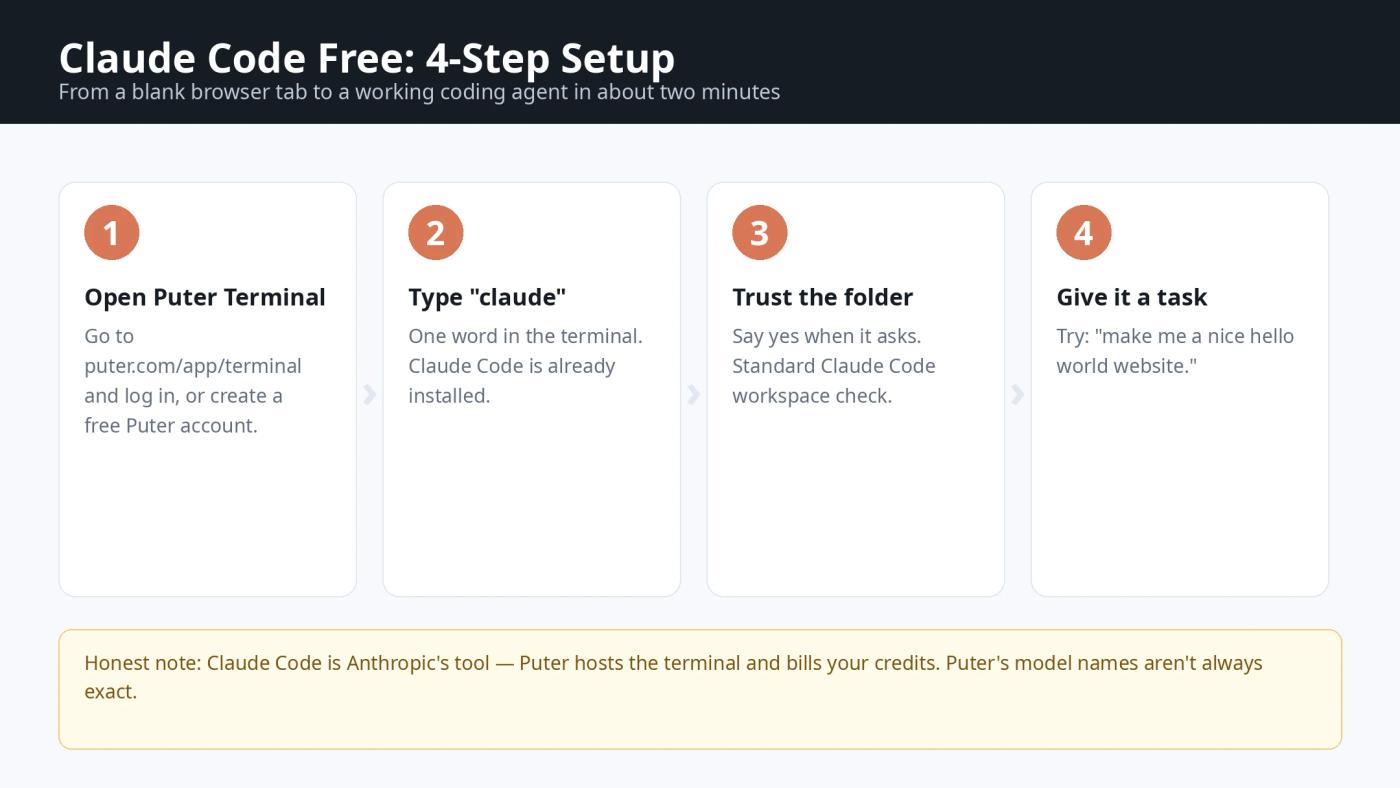
The whole thing is four steps:
- Open puter.com/app/terminal and log in, or create a free Puter account if you do not have one.
- In the terminal, type
claudeand press Enter. - When it asks you to trust the folder, say yes. This is Claude Code's standard workspace check, the same one you see in the local install.
- Give it a task in plain language. Ours was: "make me a nice hello world website."
That is the entire setup. No extensions, no config files, no keys pasted anywhere.
What the live demo showed
We pointed it at the hello-world website task on camera. The model doing the work identified as Opus 5.5, and it built the page the way Claude Code always does: it looked at the folder, wrote the files, and showed its work as it went. Two minutes from an empty folder to a finished page, without us touching an editor.
One honest note from the test, and it matters: Puter's model names are not always exact. The label said Opus 5.5 and the output quality matched a flagship, but Puter routes through its own model list, so treat the name as approximate and judge by results. This is the one place where the free route differs from paying Anthropic directly, where you know exactly which model you are billed for.
How the free credits work
Your free account's credits are the real ceiling. Every Claude Code session spends from that balance, and flagship-level models spend faster than light ones. In practice, the free budget covers a genuine trial: several real tasks, enough to learn the tool and finish small projects. It does not cover running an agentic coder all day, every day. That is what the paid plans are for.
Two habits stretch the budget. Keep tasks focused instead of asking Claude Code to explore an entire codebase for fun, and check your remaining balance in your Puter dashboard before starting something big. When the credits run out, sessions stop until the allowance resets or you top up. Nothing breaks.
Four honest limits before you rely on this
Free allowances can change. Puter sets the credit amount and the model list, and both can move. Our standing advice with every free setup we test is the same: use it while it works, and never build a deadline on top of it.
The terminal lives in a browser tab. Close the tab and the session goes with it. This is a try-and-build setup, not a server you leave running overnight.
Your prompts leave your PC. The terminal runs in your browser, but the models run on Puter's side. Do not paste client code, secrets, or private keys into it. Treat it like any cloud service.
Model names are approximate. As noted above, Puter's labels do not always match Anthropic's exactly. If exact model identity matters for your work, that alone is a reason to pay Anthropic directly.
Who should use this, and who should still pay
Use the free Puter Terminal route if you want to learn Claude Code without spending anything, if you are deciding whether agentic coding fits your workflow, or if your coding help needs are a few focused tasks a week. It is also the fastest way to show a friend what Claude Code does: send them the link, and they are two minutes from their first build.
Pay for Claude Pro or an API key if you code with AI every day, if you need exact model versions and predictable limits, or if your work involves private repositories that should stay inside a paid, accountable service. The free route is a trial that happens to be genuinely useful. The paid route is the tool as a daily driver.
FAQ
Is this the real Claude Code or a copy?
It is the real Claude Code, Anthropic's terminal coding agent, preinstalled in Puter Terminal. You run the same claude command and get the same agentic behavior: reading files, editing code, running commands. Puter hosts the terminal and bills the model usage against your Puter credits instead of an Anthropic plan.
Do I need to install anything or get an API key?
No. That is the point of this setup. The terminal runs at puter.com/app/terminal in your browser, Claude Code is already installed there, and you never touch an API key. You only need a free Puter account.
How many free credits do I get?
Our test showed 10,000 free credits on a free Puter account. Treat that number as "as of October 2026" rather than a promise: Puter can change allowances, so check your dashboard for the current figure before planning around it.
Can I use this instead of a Claude Pro subscription?
For learning and light use, yes. It is a real, working Claude Code session. If you rely on agentic coding daily, a paid plan buys you predictable access and exact model versions, while the free credits are a budget that runs out.
Why might the model name look different from Anthropic's?
Puter routes requests through its own model list, and its labels are not always exact. The video's own note says the same. Judge the setup by what it builds, and if you need a guaranteed model version, use Anthropic directly.
Is my code private in Puter Terminal?
Your terminal session runs in the browser, but the model calls go through Puter's infrastructure. Keep secrets, API keys, and client code out of it, the same as you would with any free cloud AI service.
Sources
- Puter Terminal — the browser terminal used in this setup
- Claude Code docs — Anthropic's official documentation for Claude Code
- Claude Code FREE: 100% Working Method (Tested) — our video walkthrough with the live demo
- Full Puter account guide (previous video) — signup walkthrough referenced in the video
Related Articles


