

How AI Is Changing Healthcare & Personalized Beauty
Over 1,600 FDA-authorized AI medical devices, AI skin scanners from L'Oreal, Haut.AI and Perfect Corp, plus the bias and privacy tradeoffs most coverage skips. Evidence-based guide, as of October 2026.

One algorithm reads a mammogram in a radiology suite, while a close cousin grades the pores in your selfie. That is not a metaphor. The computer vision models interpreting medical scans and the models scoring your skin for a beauty app share architectures, training methods, and sometimes even training data. Healthcare and personalized beauty are becoming two storefronts for the same underlying technology.
This guide covers what is actually deployed in both fields as of October 2026, not lab demos. On the medical side, that means more than 1,600 AI-enabled devices authorized by the U.S. FDA. On the beauty side, it means AI diagnostics from L'Oreal, Haut.AI, and Perfect Corp running inside products you can download today. It also covers the parts most coverage skips: how models perform across skin tones, what happens to your face scans, and the EU rules that just rewrote the compliance calendar.
One note before we start: this is general information about technology, not medical advice. Nothing here replaces a clinician for anything about your health.
Key Takeaways: AI in Healthcare and Personalized Beauty
- Shared stack: Computer vision, machine learning, and generative AI power both medical diagnostics and AI skin analysis.
- Real deployment: Over 1,600 FDA-authorized AI-enabled medical devices (September 2026 list), plus consumer tools from L'Oreal's ModiFace, Haut.AI, Perfect Corp, and Amorepacific.
- Hidden tradeoffs: Training data skews toward lighter skin, so accuracy varies by tone. Face scans are biometric data, and most sit outside traditional medical privacy frameworks.
- Regulation just shifted: EU AI Act transparency obligations took effect August 2, 2026, but high-risk obligations were deferred to December 2027 and August 2028 by the July 2026 Digital Omnibus.
- Direction of travel: Both fields are moving from reactive treatment toward predictive, individualized care, but the daily basics of sleep, nutrition, and movement still carry most of the weight.
One Technology Stack, Two Industries
AI in healthcare means software that analyzes medical data, including images, records, genomics, and sensor readings, to support diagnostics, drug discovery, clinical decisions, and paperwork. AI in beauty applies the same techniques to facial scans and skin biometrics, producing customized routines and product recommendations. The shared stack is what makes the two worth reading about together.
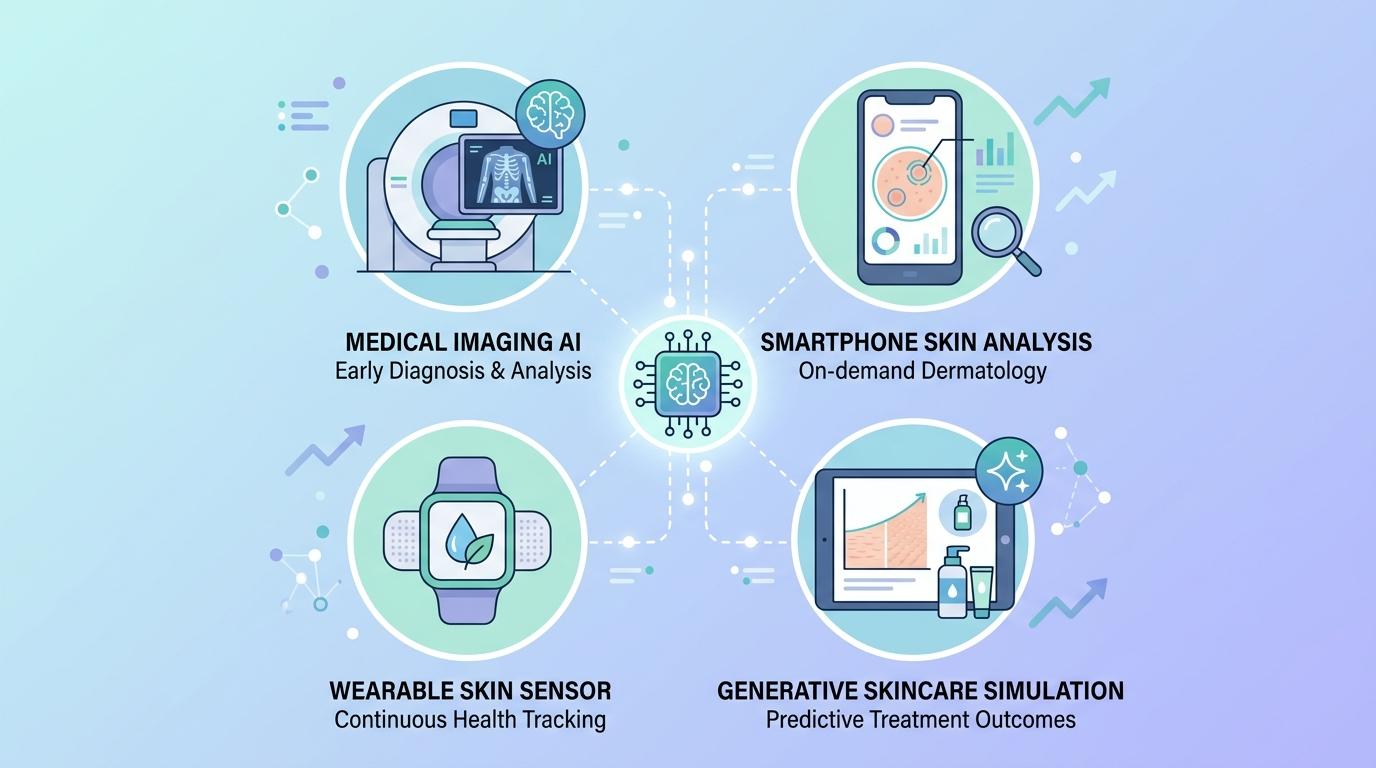
Computer vision is the clearest example. The same class of deep learning models that interprets mammograms and retinal scans also evaluates pores, pigmentation, and texture from a smartphone selfie. Machine learning does similar double duty, personalizing oncology treatment plans on one side and skincare regimens on the other by learning patterns from large labeled datasets. Generative AI completes the stack, producing synthetic medical imagery for training clinical models while simulating how skin might respond to a product over weeks or months.
That shared foundation explains why beauty companies and medical AI developers keep ending up in each other's territory. A dermatologist using AI-assisted imaging and a consumer using an AI skin analysis app are increasingly drawing on the same scientific pipeline.
What AI Is Actually Doing in Healthcare
Medical imaging remains the largest application area. As of September 2026, the FDA's public list contains over 1,600 authorized AI-enabled medical devices, with radiology accounting for roughly three quarters of authorizations and cardiology the next largest share. Most clearances run through the 510(k) pathway, which means the device demonstrated substantial equivalence to an already-marketed product, and the FDA finalized its Predetermined Change Control Plan guidance in August 2025 to govern how these models can be updated after deployment.
Open medical models are moving fast too. Google DeepMind released MedGemma 1.5 in January 2026, a 4-billion-parameter multimodal model that reads CT and MRI volumes alongside clinical text, paired with MedASR, a speech model built for clinical transcription. A Nature Medicine paper in early October 2026 described the wider MedGemma family, built on Gemma 3 in 4B and 27B sizes and released as open weights, with the authors reporting that fine-tuning it on medical tasks beats fine-tuning the base model, particularly when labeled data is scarce.
Beyond imaging, natural language processing is automating clinical documentation and pulling structured insights from free-text medical notes. AI-assisted drug discovery continues in the background, with models predicting molecular interactions to narrow candidate compounds before lab testing. And DeepMind's AMIE research system is exploring how conversational AI could support diagnostic dialogue, though that work remains research rather than a deployed product.
For authoritative numbers, the FDA's AI-enabled medical device list is the source to watch, updated periodically as new devices are authorized.
What AI Is Actually Doing in Personalized Beauty
The beauty workflow starts with a smartphone selfie. Computer vision models evaluate hydration, texture, pore visibility, wrinkles, and pigmentation, producing a skin profile in seconds. Machine learning matches that profile to product recommendations and step-by-step routines. Generative AI goes further, simulating how skin might respond to products or regimens over time.
L'Oreal is the biggest mover. Its ModiFace platform powers virtual try-on and AI skin diagnostics across Lancôme, Vichy, Maybelline, and other group brands. In June 2026 the company announced a strategic partnership with OpenAI, unveiled at VivaTech: Maybelline virtual try-on moves directly into ChatGPT conversations, OpenAI's GPT-Rosalind life sciences model will analyze the skin microbiome at scale starting with La Roche-Posay, and L'Oreal Paris runs Beauty Genius, an agentic AI assistant trained on thousands of real beauty consultations and a skin atlas with 150,000 dermatologist annotations. Kérastase's K-SCAN, an AI diagnostic camera, is already in use across 9,000 salons.
Haut.AI licenses its stack to global brands including Neutrogena, Beiersdorf, and Ulta Beauty. Its Face Analysis 3.0 engine handles diagnostics, SkinGPT generates photorealistic simulations of how skin may change over time, and Skin.Chat acts as a conversational skincare consultant. In June 2026 Haut.AI partnered with Olay to add a Virtual Companion to the OLAY Skin Advisor, using clinical data to simulate how recommended products may affect a model matched to the user's own skin.
Perfect Corp's YouCam AI Beauty Agent brings conversational beauty AI to consumers through mobile apps. Amorepacific's Skinsight, a wearable skin sensor co-developed with an MIT research group, won a CES 2026 Innovation Award in the Beauty Tech category, measuring aging-related skin signals continuously. At the same show, Samsung demonstrated an AI Beauty Mirror using camera-based optical diagnostics trained on more than 450,000 data cases.
These tools slot best into a complete, well-structured regimen rather than replacing one. For how AI skin analysis fits alongside traditional skincare, hair, and makeup steps, see our full walkthrough in the Complete Beauty Routine 2026: Skin, Hair & Makeup guide.
What Most Guides Skip: Bias, Privacy, and the New EU Rules
Most coverage of AI in healthcare and beauty celebrates capability. Less attention goes to where the technology falls short, who it serves worst, and how fast the rules are changing.
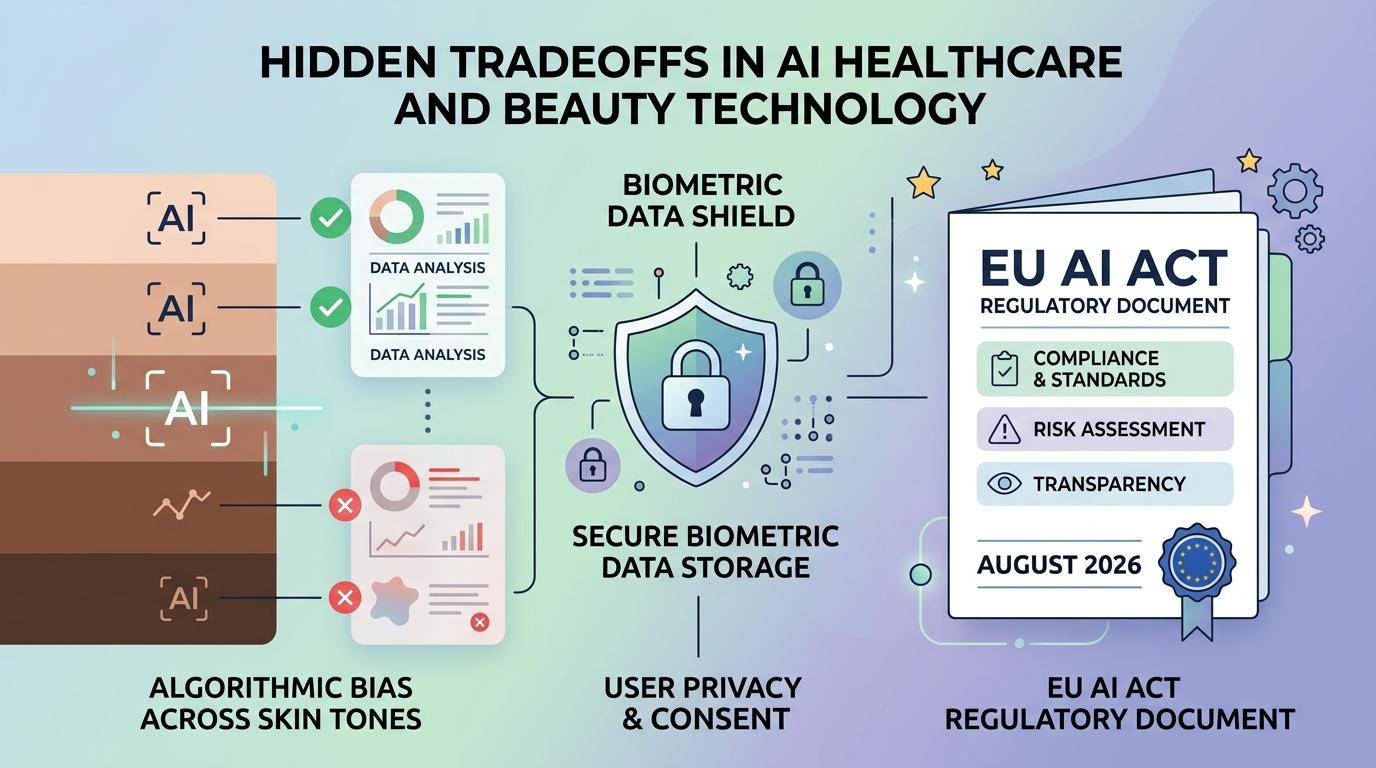
Algorithmic bias across skin tones is the documented weak point. Dermatology image libraries have long skewed toward lighter skin, and models trained on those datasets tend to perform less accurately on darker skin, whether flagging a suspicious lesion or analyzing pigmentation in a beauty app. The FDA has acknowledged gaps in demographic transparency, and only a limited share of authorized devices publicly report performance broken down by race, age, or sex. An independent test published in September 2026 by Which? put 17 online AI skin scanning tools through 120 scans with 30 people and found that differing skin tones and poor lighting could skew results, with one major retailer's tool removed from its website after the findings. The practical takeaway: favor tools whose makers disclose diverse training data and publish performance breakdowns across demographics.
Biometric privacy sits in a regulatory gray zone. AI skincare and health apps typically require facial scans, skin images, or personal health information, building sensitive biometric databases that mostly sit outside traditional medical privacy frameworks. Before uploading scans, review the app's data-sharing policy, retention terms, and third-party access. If a policy is vague about how long face data is kept, treat that as an answer.
The EU regulatory picture changed in 2026. Transparency obligations under the EU AI Act took effect on August 2, 2026: AI systems that interact with people must disclose themselves, and generated content must carry machine-readable labels. But the high-risk obligations did not arrive on schedule. In July 2026 the EU signed the Digital Omnibus on AI, deferring high-risk requirements to December 2, 2027 for standalone AI systems and August 2, 2028 for AI embedded in regulated products. That deferral does not mean beauty AI escapes scrutiny: tools making health-adjacent diagnostic claims may still land in the high-risk category, and the transparency rules apply now. Track the current state of play at artificialintelligenceact.eu.
Six Mistakes People Make With AI Health and Beauty Tools
- Treating AI skin analysis as a dermatologist's diagnosis. These tools are screening aids, not clinical replacements. Use them to flag concerns and guide routines, then confirm anything medically significant with a licensed dermatologist.
- Ignoring data privacy permissions. Many apps collect biometric facial data and skin images. Read the data-sharing policy, retention terms, and third-party access rules before uploading a single scan.
- Assuming every tool works equally well on every skin tone. Bias is well documented. Choose tools from companies that disclose training data diversity and publish demographic performance data.
- Letting one app make medical decisions. AI complements professional care. It works for monitoring, education, and early signals, not for final answers about treatment.
- Expecting instant transformation from AI-personalized skincare. Better recommendations still meet the same biology. Most active ingredients need weeks to months to show measurable results, no matter how accurate the analysis was.
- Relying on outdated information. Tools, guidance, and regulations from even two or three years ago may already be obsolete. Check the date on anything you act on.
Where AI in Healthcare and Beauty Is Heading
The most important shift ahead is the dissolving boundary between medical dermatology and cosmetic beauty. L'Oreal announced in December 2025 that it would raise its stake in Galderma, the Swiss dermatology company, to 20 percent, building on its initial 2024 investment and adding joint scientific research projects. Meanwhile Amorepacific's move into wearable skin sensors shows beauty companies stepping directly into health-adjacent territory, while medical AI developers increasingly build consumer-facing interfaces.
Regulation will keep shaping the field, on the EU's revised timeline, and the underlying trend is a decisive move from reactive treatment to predictive, personalized wellness. But technology only amplifies the basics. Sleep, nutrition, and movement still do most of the work, which is why our Everyday Health Guide: Sleep, Nutrition & Fitness remains the best starting point for long-term wellbeing.
FAQ: AI in Healthcare and Personalized Beauty
How is AI used in healthcare today?
AI supports medical imaging diagnostics in radiology and cardiology, accelerates drug discovery, powers clinical decision support, automates documentation, and enables remote patient monitoring. As of September 2026, over 1,600 FDA-authorized AI-enabled medical devices are in clinical use across U.S. healthcare, with radiology the largest share at roughly three quarters.
Can AI really help with skincare recommendations?
Yes, with realistic expectations. AI skin analysis tools evaluate hydration, texture, pores, wrinkles, and pigmentation from a smartphone selfie, then match findings to product recommendations. Tools from L'Oreal's ModiFace, Haut.AI, and Perfect Corp are deployed by major beauty brands including Lancôme, Vichy, Maybelline, Neutrogena, and Olay. Independent testing shows results vary with lighting and skin tone, so treat the output as guidance rather than gospel.
Will AI replace doctors or dermatologists?
No. AI handles pattern recognition and large-scale data processing, but diagnosis, treatment decisions, patient communication, and the care relationship remain human-led. Regulators and clinicians consistently describe AI as a tool that supports professionals rather than replacing them.
What are the ethical concerns of AI in healthcare and beauty?
The main ones are algorithmic bias across skin tones and demographics, biometric data collection and privacy risk, limited transparency in how models reach conclusions, and regulation evolving slower than the technology. On the EU front, AI Act transparency obligations took effect in August 2026, while high-risk obligations were deferred to 2027 and 2028.
What brands use AI for personalized skincare?
L'Oreal (ModiFace across Lancôme, Vichy, Maybelline, and a 2026 OpenAI partnership adding ChatGPT try-on), Haut.AI (Face Analysis 3.0, SkinGPT, and a 2026 Olay partnership), Perfect Corp (YouCam AI Beauty Agent), and Amorepacific (Skinsight wearable sensor). Most operate through smartphone apps, salon diagnostics, or in-store experiences.
Related Articles


