Your Everyday Health Guide: Sleep, Nutrition & Fitness
Most people try to fix their energy, eating, and exercise habits one at a time — and wonder why nothing sticks. This everyday health guide to sleep, nutrition, and fitness covers all three as one connected daily system, including a practical timing framework that quietly amplifies everything you are already doing right.

Review
You set the alarm with good intentions. You planned to eat better this week. You told yourself you'd get back to exercising. And yet, by Thursday, you're exhausted, reaching for whatever's convenient, and skipping the workout again — not because you lack willpower, but because the energy simply isn't there.
This cycle is more common than most people realize, and it rarely comes down to motivation alone. Sleep, nutrition, and fitness are not three separate challenges to solve one at a time. They form a single, interconnected daily system — and when one is off, the others suffer with it.
This everyday health guide to sleep, nutrition, and fitness is built for the average adult who wants to feel better, move more, and eat well without overhauling their entire life overnight. It covers how each pillar works, why they reinforce each other, and — critically — how the timing of your habits within a 24-hour window can quietly amplify or undermine everything else you're doing right.
Start with the key takeaways below, then read as far as you need.
What You'll Learn: Sleep, Nutrition and Fitness Basics
- Adults need 7–9 hours of sleep per night for full physical and cognitive recovery
- A balanced diet built on whole foods, lean protein, fiber, and healthy fats supports both sustained energy and sleep quality
- 150 minutes of moderate exercise per week is the widely accepted baseline for meaningful health benefits
- All three pillars reinforce each other — improving one makes the others measurably easier to maintain
- Timing matters: when you eat, move, and wind down directly affects how well each pillar performs across the day
- Consistency over perfection is the operative principle — small, repeatable habits compound into lasting results
What Is an Everyday Health Guide and Why It Matters
An everyday health guide is a practical framework for building sustainable daily habits around the three core pillars of well-being: sleep, nutrition, and fitness. It is not a rigid program, a specialized athlete's protocol, or a medical treatment plan. It is a structured way for the average adult — someone trying to feel better, think more clearly, and maintain their energy through the day — to understand what their body actually needs and how to consistently provide it.
Most people approach these three areas as separate problems. Sleep feels like a scheduling issue. Nutrition feels like a willpower issue. Fitness feels like a time issue. In reality, all three are governed by the same underlying biology, and a daily sleep, nutrition, and fitness routine that treats them as one connected system is significantly more effective than addressing each in isolation.
Here is how the three pillars function individually before we examine how they interact:
- Sleep is the body's primary recovery and regulation system — it governs hormones, mood, immune function, and cognitive performance
- Nutrition is the fuel layer — what and when you eat shapes your energy levels, metabolic function, and your body's ability to repair itself
- Fitness drives circulation, muscular strength, and mental resilience, while also directly influencing both sleep depth and appetite regulation
Neglecting any one pillar creates a cascading effect on the other two. That bidirectional relationship is the foundation everything else in this guide builds on.
The Three Pillars of Health and How Each One Works
Understanding each pillar clearly is the first step toward building a routine that holds. Here is what the science and established health guidance actually say about each one.
Sleep — Your Body's Recovery System
Quality sleep is defined by three factors: duration, consistency, and environment. Most adults need 7–9 hours per night, but sleeping at irregular times — even for the same total hours — significantly reduces the restorative value of that sleep. This is because the body runs on a circadian rhythm, an internal 24-hour clock that regulates cortisol, melatonin, body temperature, and dozens of other biological processes. When your sleep and wake times shift unpredictably, that clock loses its calibration, and energy, mood, and hormone balance suffer as a result.
Sleep itself cycles through non-REM and REM phases throughout the night. Non-REM sleep handles physical repair — tissue recovery, immune strengthening, and metabolic restoration. REM sleep manages memory consolidation and emotional regulation. Both are essential, and both require sufficient, uninterrupted duration to complete properly. Common disruptors that cut these cycles short include caffeine consumed in the afternoon, screen exposure close to bedtime, and irregular schedules that shift the body's sleep window from night to night.
Nutrition — Fuel That Shapes How You Feel
A foundation of good nutrition is less about individual foods and more about consistent dietary patterns. The well-supported baseline is a plate built around lean protein, complex carbohydrates, healthy fats, and fiber-rich vegetables — a combination that supports stable blood sugar, sustained energy, and adequate micronutrient intake across the day.
Blood sugar balance is particularly important and often underestimated. When meals are skipped or built around refined carbohydrates and sugar, blood sugar spikes and crashes drive energy dips, cravings, and poor food decisions later in the day. Keeping blood sugar stable through balanced, regular meals smooths energy levels and reduces the late-night hunger that often leads to poor nutritional choices before bed.
The relationship between nutrition and sleep runs in both directions. Poor dietary patterns — particularly those high in sugar and low in fiber — are linked to lighter, more disrupted sleep. And poor sleep actively disrupts the appetite-regulating hormones ghrelin and leptin, increasing hunger and cravings for calorie-dense food the following day. Dietary patterns, not individual superfoods, determine which direction that cycle runs.
Fitness — Movement as Daily Medicine
The widely accepted physical activity guideline for adults, as outlined by the World Health Organization, is approximately 150 minutes of moderate-intensity cardiovascular activity per week, combined with two or more sessions of resistance training. A well-rounded fitness routine also includes mobility and flexibility work, which supports joint health and reduces injury risk over time.
The benefits of regular movement operate on two timescales. Immediately, a single exercise session improves mood, reduces anxiety, lowers blood sugar, and — critically — deepens sleep quality that same night. Over weeks and months, consistent physical activity strengthens bones and muscle, supports healthy body weight, improves cardiovascular function, and significantly reduces the risk of chronic conditions including type 2 diabetes and heart disease.
One principle holds across all fitness levels: consistency outperforms intensity. Three moderate workouts completed every week for a year will produce far greater and more durable results than intense training done sporadically. Any movement practiced regularly is more effective than the perfect program followed inconsistently.
Why Sleep, Nutrition and Fitness Work Best Together
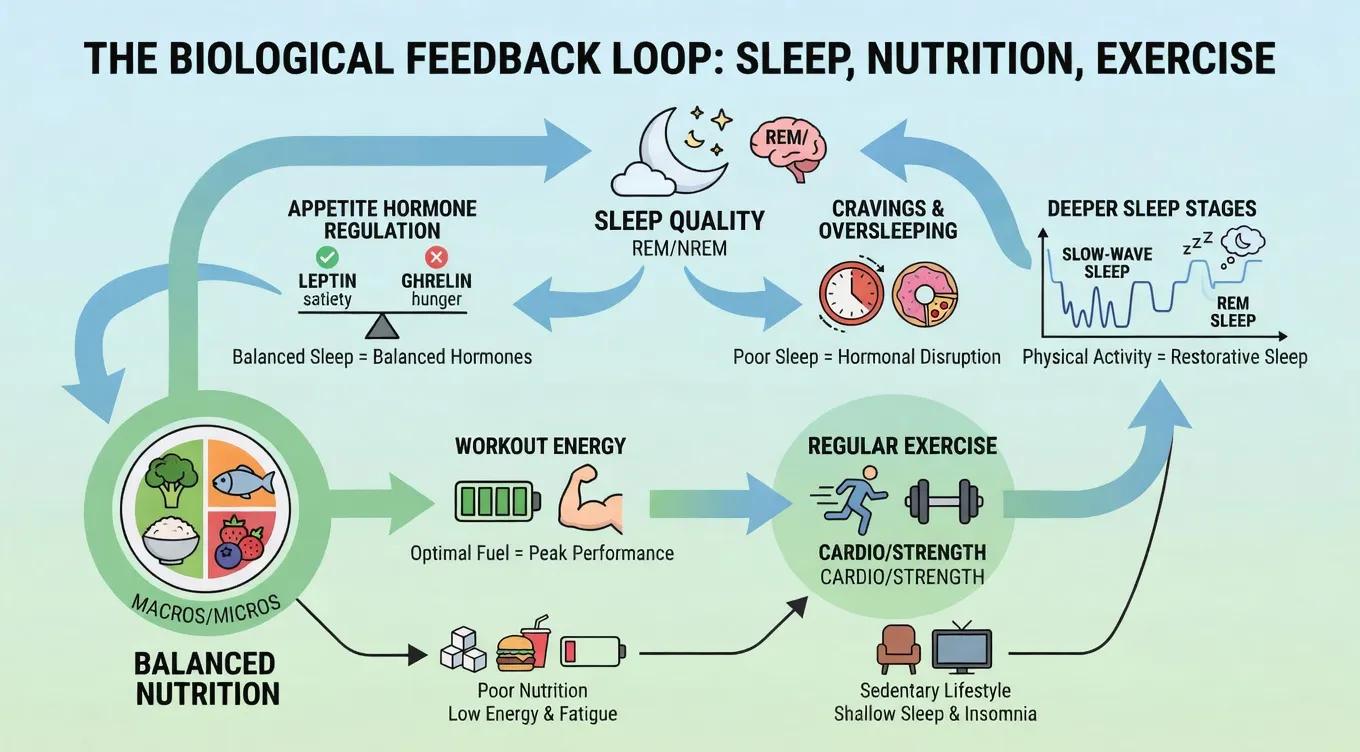
Most people know, in general terms, that sleep, nutrition, and fitness are all good for you. What is less commonly understood is that these three pillars do not simply coexist — they actively regulate each other through a continuous biological feedback loop. Addressing all three simultaneously is not harder than fixing one in isolation; it is actually more effective, because progress in one area creates the conditions for progress in the others.
Consider a concrete example most people have experienced firsthand. After a poor night's sleep, hunger feels more urgent, cravings shift toward high-calorie and high-sugar foods, and the motivation to exercise drops significantly. This is not a coincidence or a lack of discipline — it is the direct result of ghrelin rising and leptin falling when sleep is insufficient, two appetite hormones that govern hunger and satiety. One bad night measurably changes what you want to eat the next day.
The loop runs in every direction. Regular exercise reduces pre-sleep anxiety, lowers core body temperature in the hours after a workout, and increases the proportion of deep, restorative non-REM sleep. A diet built on whole foods and stable blood sugar provides the sustained energy needed to train consistently and recover well. And consistent, adequate sleep is what allows both nutrition and exercise to deliver their full return — without it, muscle repair slows, cortisol stays elevated, and the motivation to maintain healthy habits for sleep and exercise gradually erodes.
The Reinforcement Loop at a Glance:
- Sleep well → appetite hormones regulate → healthier food choices → better workout energy
- Regular exercise → deeper sleep stages → faster physical recovery → more consistent energy
- Balanced nutrition → stable blood sugar all day → more consistent movement → better rest at night
- Neglect any one pillar → the other two become harder to maintain, not just independently affected
This is why the most sustainable approach is not to fix sleep first, then nutrition, then fitness in sequence. It is to make modest, simultaneous improvements across all three — because each small gain compounds through the others.
The Daily Chrono-Stacking Framework for Better Health
What Most Everyday Health Guides Don't Tell You About Timing
Most guides cover what to do. Very few address when — and the timing of your habits within a 24-hour window makes a measurable difference to how well each pillar performs.
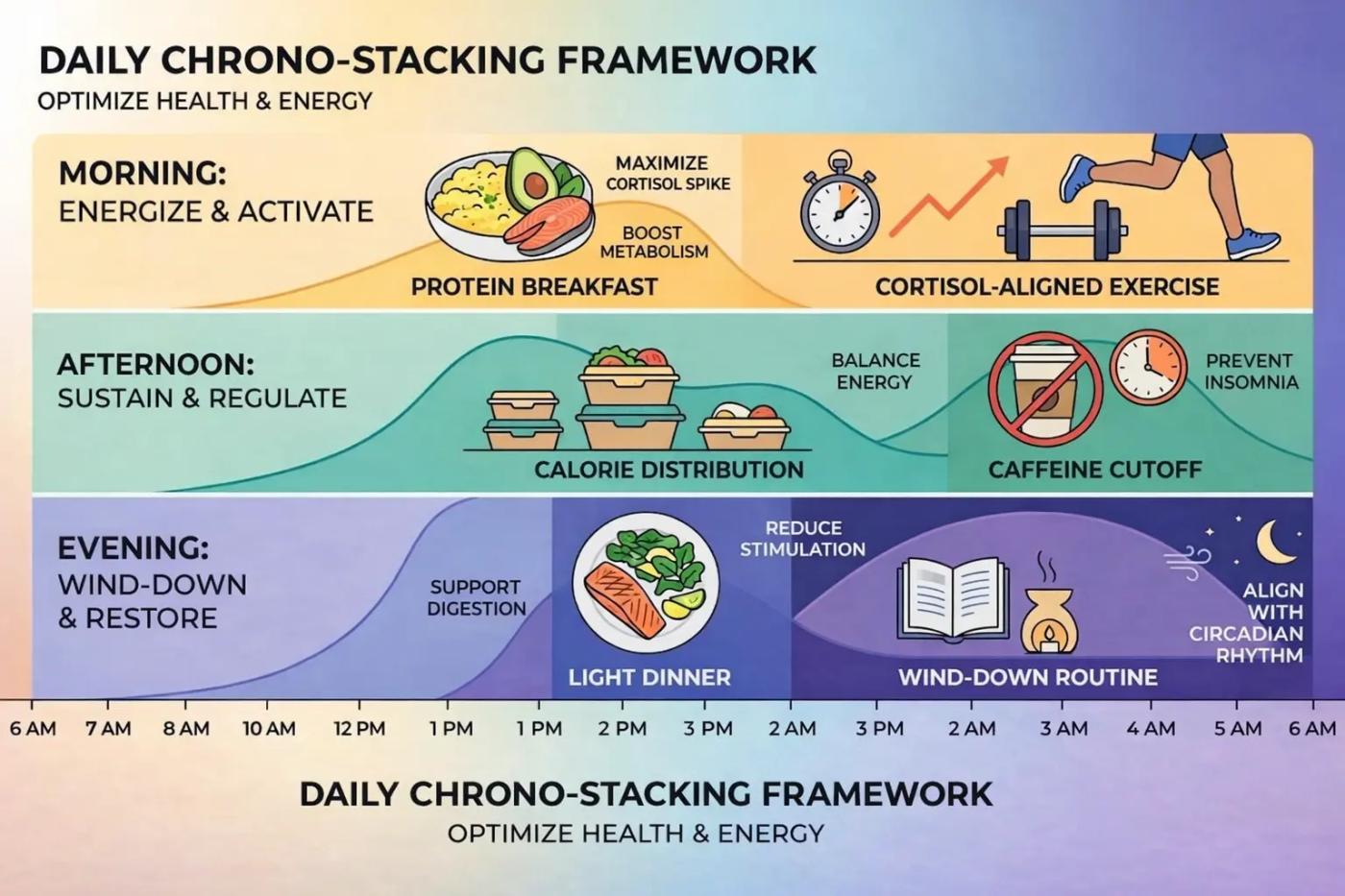
This is the basis of chrono-nutrition: the science of aligning meal timing with the body's circadian rhythms to optimize digestion, metabolism, and sleep outcomes. Research published through the National Institutes of Health confirms that when you eat affects metabolic response independently of what you eat — the same meal consumed at different times of day produces different hormonal and digestive outcomes. The same principle extends to movement and sleep preparation. Sequencing these habits deliberately — what this guide calls chrono-stacking — compounds their individual benefits rather than letting them work in isolation.
The framework divides your day into three time zones, each with a clear role.
Morning — Anchor Your Rhythm
The morning window sets the tone for everything that follows. Eating a protein-rich breakfast with complex carbohydrates within an hour or two of waking stabilizes blood sugar early and reduces the likelihood of energy crashes and cravings later in the day. Morning is also the optimal window for higher-intensity exercise, as it aligns with the body's natural cortisol peak — channeling that alertness into physical output rather than working against it. Natural light exposure in the first hour after waking reinforces the circadian clock directly, improving both daytime energy and nighttime melatonin production.
Afternoon — Sustain Without Crashing
The afternoon window is about maintenance and protection. Consuming the majority of daily calories before 3–4 pm supports optimal metabolic function and allows sufficient digestion time before sleep. Moderate exercise — walking, strength training, cycling — remains highly effective in the early afternoon and carries none of the sleep-disruption risk associated with late evening workouts. Caffeine intake should taper off by mid-afternoon; for most adults, caffeine consumed after 2–3 pm measurably delays sleep onset, even when no alertness effect is consciously felt.
Evening — Wind Down in Layers
The evening window is the most commonly mismanaged of the three. A lighter dinner eaten at least two hours before bed supports overnight digestion and reduces the blood sugar fluctuations that fragment sleep. Foods that are fried, spicy, or high in saturated fat slow gastric emptying and are consistently linked to poorer sleep architecture. Gentle movement — a short walk or light stretching — is appropriate and beneficial in the evening, but vigorous exercise within two hours of bedtime raises core body temperature and cortisol in ways that delay sleep onset for many adults. Beginning a wind-down routine 30–45 minutes before bed — dimmed lighting, reduced screen exposure, a consistent sleep time — gives the brain the environmental cues it needs to transition into sleep mode reliably.
Real-World Application: How to Build Your Daily Routine
The framework above works best when it is translated into specific, repeatable actions. The following steps are designed to be beginner-friendly and adaptable — not a rigid schedule, but a practical structure you can shape around your existing life.
- Set one consistent wake time and protect it daily, including weekends. This is the single highest-leverage sleep habit available. A fixed wake time anchors the circadian clock, stabilizes melatonin timing, and gradually improves sleep quality even before any other change is made.
- Build every meal around a simple plate formula. Fill half the plate with vegetables, one quarter with a lean protein source, and one quarter with a complex carbohydrate. Add a small amount of healthy fat. This structure does not require calorie counting and naturally supports blood sugar stability throughout the day.
- Schedule movement like a fixed appointment. Three 30-minute sessions per week is a realistic and effective starting point that already begins delivering measurable health benefits. Blocking these sessions in advance — rather than fitting them in when time allows — is the difference between a plan and a habit.
- Identify your personal caffeine cutoff and respect it. For most adults, stopping caffeine intake by early to mid-afternoon protects sleep onset without requiring any reduction in morning or late-morning consumption. Two weeks of consistent cutoff timing is enough to notice the difference in sleep quality.
- Build a 20-minute wind-down ritual and use it every night. Consistent pre-sleep cues — reading, light stretching, dimmed lighting, no screens — signal the brain to begin the transition into sleep mode. Repetition is what gives this ritual its power; the routine itself matters less than the consistency with which it is followed.
- Prepare your sleep environment deliberately. A cool, dark, and quiet room measurably improves sleep depth and continuity. Small adjustments — blackout curtains, a lower thermostat setting, white noise if needed — have a disproportionate impact on sleep quality relative to the effort they require.
- Plan the next day's meals the evening before. Reducing food decision fatigue is one of the most underrated nutritional strategies available. When meals are decided in advance, the likelihood of defaulting to convenient but poor choices drops significantly — particularly during low-energy periods in the afternoon and evening.
Common Mistakes That Undermine Sleep, Nutrition and Fitness
Small, repeated errors across sleep, nutrition, and fitness tend to cancel out genuine effort. These are the most common — and most consequential.
- Treating sleep as the flexible variable. Many adults protect their workout schedule and meal plan while routinely cutting sleep short. This is counterproductive — sleep deprivation directly degrades workout performance, impairs muscle recovery, and undermines the food choices made the following day. Sleep is not optional recovery time; it is the foundation the other two pillars rest on.
- Chasing one pillar while neglecting the others. Overtraining without adequate nutrition and sleep produces diminishing returns and significantly increases injury risk. The body requires all three inputs to adapt and improve. Optimizing one area while ignoring the others creates an imbalance the system cannot sustain.
- Skipping breakfast to reduce calorie intake. This approach typically disrupts blood sugar regulation from the start of the day, reduces available energy for morning movement, and leads to greater overall calorie consumption later — particularly in the evening when the body is least equipped to metabolize a large meal efficiently.
- Scheduling high-intensity workouts late in the evening. Vigorous exercise close to bedtime elevates core body temperature and cortisol levels, both of which signal the body to remain alert. For many adults, this delays sleep onset by 30 minutes or more — eroding the recovery that the workout was intended to support.
- Ignoring meal timing entirely. Eating large, heavy meals within two hours of bedtime slows digestion, disrupts blood sugar overnight, and fragments sleep architecture. The content of the meal matters, but so does when it is consumed.
- Expecting results before the compounding effect begins. Building integrated habits across sleep, nutrition, and fitness typically requires 3–6 weeks of consistency before the compounding benefits become clearly noticeable. Abandoning the approach before that window closes is the most common reason sustainable progress stalls.
Expert tip: Start with the single weakest pillar. Improve that one area consistently for two weeks before introducing changes to the others. This prevents overwhelm, builds early confidence, and creates enough momentum to make the next layer of change feel manageable rather than burdensome.
FAQ — Sleep, Nutrition & Fitness Questions Answered
Q: How does nutrition affect sleep quality?
What you eat — and when — directly influences how well you sleep. Diets high in fiber and balanced in protein support more restorative sleep, while high sugar intake, late-night heavy meals, and excessive caffeine are consistently linked to lighter, more disrupted sleep cycles.
Q: How much sleep do adults actually need for fitness goals?
Most adults need 7–9 hours per night. For those pursuing fitness goals, sleep is the window in which muscle repair and growth hormone release occur. Chronic under-sleeping actively undermines training results, even when workouts and nutrition are well managed.
Q: What is the best daily routine for sleep, nutrition, and fitness?
A practical structure includes a protein-rich morning meal and light-to-moderate exercise early in the day, balanced meals weighted toward the first half of the day, and an evening wind-down that avoids heavy food and vigorous exercise in the two hours before bed.
Q: Can poor eating habits cause insomnia?
Poor dietary patterns — particularly those low in fiber, high in saturated fat, or high in sugar — are associated with less restorative sleep and a higher risk of insomnia symptoms. Meal timing also plays a role: eating dinner too close to bedtime slows digestion and increases nighttime disruptions.
Q: Is it better to exercise in the morning or evening for better sleep?
Morning and early afternoon exercise generally aligns best with sleep quality, working with natural cortisol rhythms and allowing body temperature to normalize before bedtime. Evening exercise is not harmful for everyone, but high-intensity workouts within two hours of sleep can delay sleep onset in many adults.
Building Everyday Health Habits That Actually Stick
Sleep, nutrition, and fitness are not three separate goals competing for your time and attention. They are one integrated system, and the most reliable path to sustainable well-being is treating them that way.
The chrono-stacking insight this guide introduced is worth carrying forward: it is not enough to do the right things — when you do them matters. Anchoring meals, movement, and wind-down habits to the right windows of your day quietly amplifies the return on every effort you are already making.
The most practical next step is also the most manageable one. Choose one habit from each pillar to implement this week — a consistent wake time, a balanced breakfast, and a single scheduled workout. Do not wait until the full routine feels ready. Start with those three, repeat them until they require no decision, then build from there.
This everyday health guide to sleep, nutrition, and fitness is not about perfection. It is about consistency applied in the right direction. Progress compounds — and it starts with what you do today.