The Complete Beauty Routine 2026: Skin, Hair & Makeup
Most people are still building their beauty routines like it's 2020 — and quietly wondering why nothing works anymore. This guide breaks down the complete beauty routine 2026: the barrier-first skincare shift, the scalp-as-skin rule, and the treatment-infused makeup changing everything. Walk away knowing exactly what to keep, what to drop, and what to try first.

Beauty in 2026 no longer lives in three separate bathrooms drawers. Skincare, haircare, and makeup have quietly merged into one connected system — and building a complete beauty routine 2026 now means thinking about your skin, scalp, and cosmetics as a single ecosystem rather than three competing silos. The old playbook of aggressive actives, ten-step stacks, and heavy full-coverage makeup is being replaced by something smarter: barrier-first skincare, scalp care treated with the same seriousness as facial care, and foundations formulated with peptides and ceramides instead of just pigment.
This guide walks you through exactly what that shift looks like in practice. You'll learn how to build a modern AM and PM routine, which ingredients are genuinely defining 2026 (exosomes, PDRN, peptides), why minimalism is outperforming maximalism, and how the skincare-haircare-makeup convergence actually delivers better results with fewer products. Whether you're starting from scratch or rebuilding a routine that stopped working, this is the one-stop resource for beauty in 2026 — grounded in skin longevity, not quick fixes.
Your 2026 Beauty Snapshot
Short on time? Here's everything this guide covers at a glance — the core shifts defining beauty this year:
- Barrier-first skincare replaces aggressive routines — protecting the skin barrier now outperforms stacking strong actives.
- Scalp health is the new skincare — the scalp is being treated with the same ingredients and logic as the face.
- Makeup is becoming treatment-infused — foundations, blushes, and lip products now deliver peptides, ceramides, and hydration.
- Exosomes, PDRN, and peptides define 2026 ingredients — regeneration and repair replace surface-level exfoliation.
- Minimalist routines outperform 10-step stacks — fewer, smarter products deliver compounding results.
- At-home beauty tech goes mainstream — red light therapy and LED devices move from clinics to bathrooms.
What Is a Complete Beauty Routine in 2026?
A complete beauty routine in 2026 is an integrated system where skincare, haircare, and makeup work toward one shared goal: healthy, resilient skin and scalp that age well over time. It's no longer three disconnected silos competing for space on your shelf. The foundation is skin health, and everything else — the shampoo, the foundation, the lip balm — is built to support that foundation rather than work against it.
The biggest philosophical shift is the move from "anti-aging" to skin longevity. Instead of chasing quick corrections after damage appears, a modern skincare routine 2026 focuses on prevention: protecting the skin barrier, maintaining hydration, supporting the microbiome, and using gentle, consistent actives rather than aggressive ones. The goal isn't to look younger next week — it's to keep your skin, scalp, and hair functioning well for decades. Skin longevity also doesn't happen on the surface alone — consistent sleep, nutrition, and daily movement shape how your skin repairs, hydrates, and ages just as much as any serum does.
This is also why minimalism is winning. The old ten-step stack often did more harm than good, overwhelming the barrier and triggering irritation that users then tried to fix with even more products. A beauty routine for beginners in 2026 looks almost identical to an advanced one: a gentle cleanser, a hydrating serum, a targeted treatment, moisturizer, and SPF. The difference is the knowledge behind the choices, not the number of bottles.
Preventive over reactive. Supportive over aggressive. Connected over siloed. That's the 2026 blueprint — and every section that follows builds on it.
How to Build Your 2026 Beauty Routine (Step-by-Step)
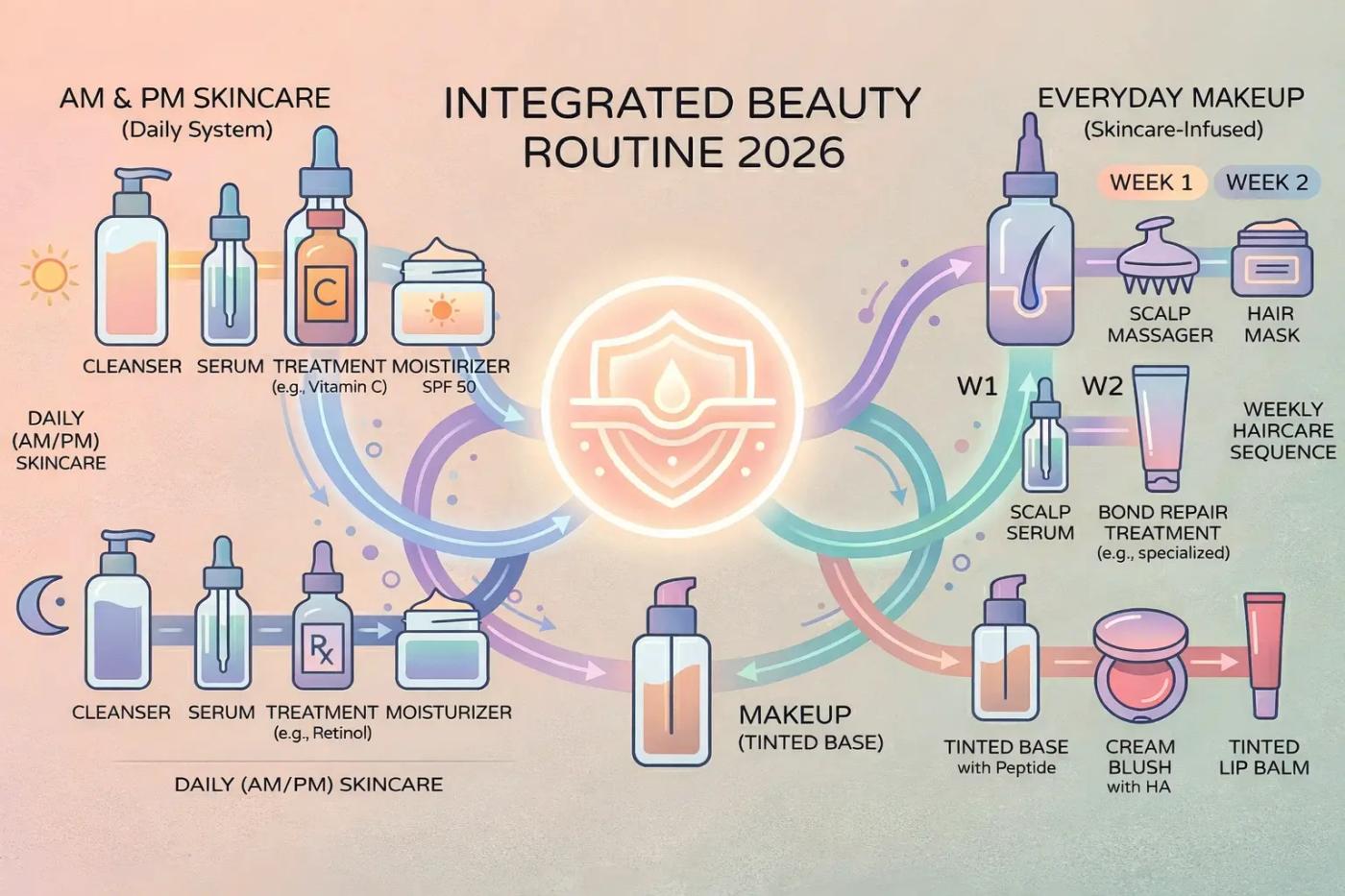
Building a modern beauty routine isn't about collecting more products — it's about sequencing the right few in a way that lets skincare, haircare, and makeup reinforce each other. The structure below gives you the three core mini-routines that together form a complete beauty routine 2026, each designed around the barrier-first, skin-longevity philosophy.
Your AM + PM Skincare Routine
Your skin does two different jobs day and night, so your routine should too. Mornings are for protection; evenings are for repair.
- Gentle cleanser — a low-pH, non-stripping formula that respects the skin barrier.
- Hydrating serum — hyaluronic acid or polyglutamic acid to lock in moisture before anything else goes on.
- Treatment — niacinamide in the AM for barrier support and tone; a rotated active (retinoid, peptide, or PDRN serum) in the PM.
- Moisturizer — ceramide-rich to seal everything in and reinforce the barrier overnight.
- SPF 30+ (AM only) — the single most important anti-aging step, non-negotiable. The American Academy of Dermatology consistently names daily broad-spectrum SPF the most effective preventive skincare habit.
The PM version swaps SPF for your rotated active. Alternate actives every other night instead of stacking — your barrier will thank you.
Your Weekly Haircare & Scalp Routine
Scalp health is skin health. Treat it that way.
- Wash 2–3 times weekly — over-washing strips the scalp microbiome.
- Scalp care day (1×/week) — a scalp serum or exfoliating treatment with salicylic acid or niacinamide.
- Bond repair treatment (1×/week) — for anyone who heat-styles or colors.
- Heat protection — every single time, even on low heat.
Your Everyday Makeup Routine
Modern makeup is treatment-infused — it works with your skincare, not on top of it.
- Skincare-infused base — a tinted serum or skin tint with peptides or hyaluronic acid.
- Cream blush — blends into the skin for that lit-from-within finish.
- Diffused lip — a tinted balm with ceramides instead of drying matte formulas.
- Soft-focus finish — a light setting mist, not heavy powder.
Why the Skincare-Haircare-Makeup Convergence Matters
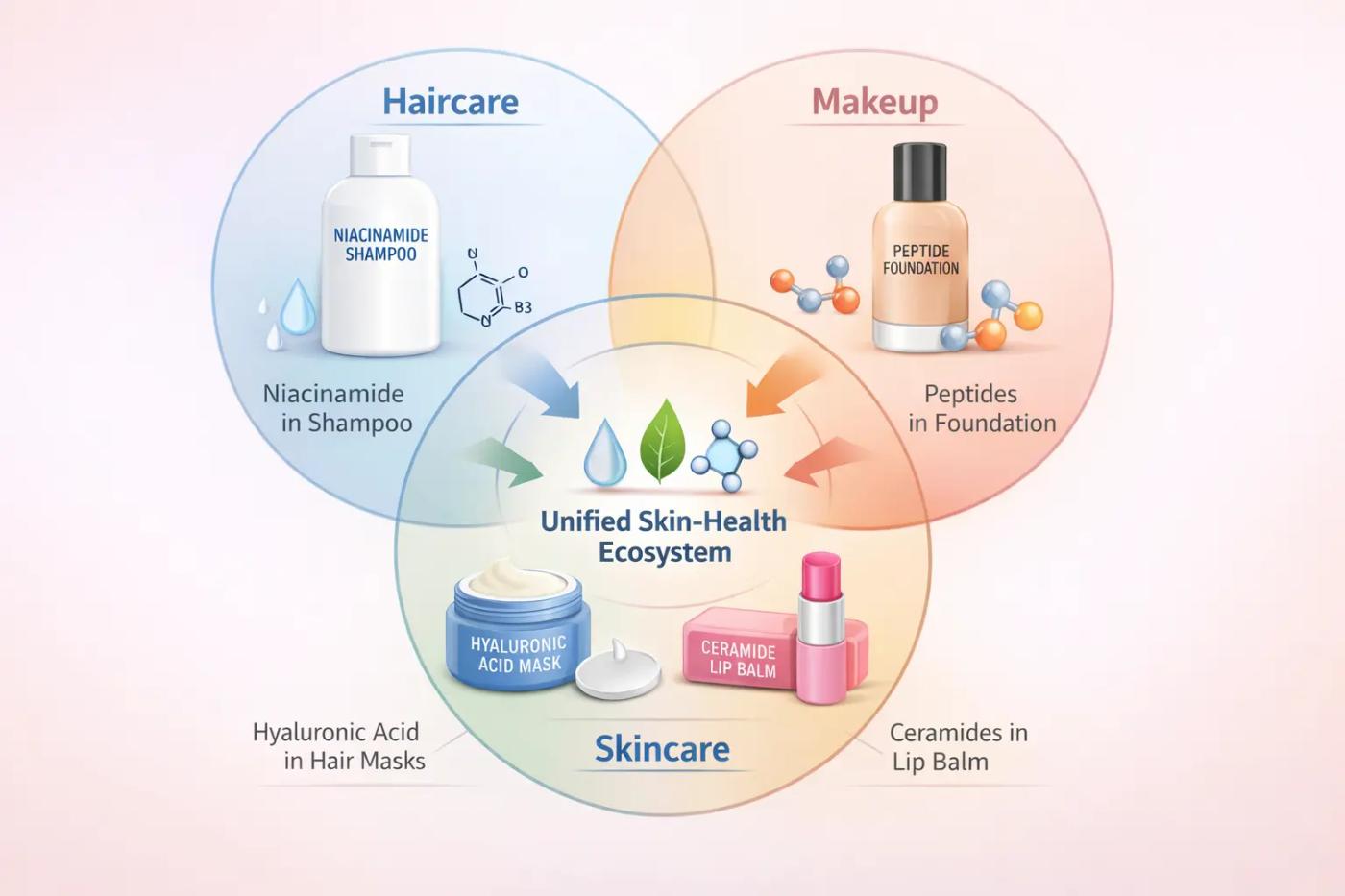
For decades, the beauty industry sold three separate promises: skincare would fix your skin, haircare would fix your hair, and makeup would cover whatever was left. In 2026, that model is collapsing — and the reason is simple. When all three categories pull in the same direction, the results compound. When they don't, they cancel each other out.
The convergence matters because it solves the four biggest frustrations modern users have with beauty: wasted time, wasted money, product overload, and inconsistent results. An integrated routine doesn't just feel simpler — it actually performs better, because every product reinforces the one before it instead of undoing it.
Here's what the convergence delivers in practice:
- Time savings — a skincare-infused foundation replaces three steps (moisturizer, primer, base) without sacrificing coverage or care.
- Cost efficiency — fewer, multifunctional products cost less than a 10-step stack, and you finish what you buy.
- Compounding results — when your shampoo, serum, and foundation all support the skin barrier, improvements build week over week instead of resetting.
- Reduced product overload — no more conflicting actives, no more layering confusion, no more half-used bottles.
- Consistency across zones — your face, scalp, and lips get the same quality of care, not just the photogenic parts.
The real-world examples are everywhere once you start looking. Niacinamide in shampoo now soothes scalp inflammation the same way it calms facial redness. Peptides in foundation support collagen while you wear coverage, turning an eight-hour workday into an eight-hour treatment. Ceramides in lip balm repair the lip barrier instead of just sealing it. Hyaluronic acid in hair masks hydrates strands using the same mechanism it uses on skin. Even glass skin — the finish everyone wants — is no longer achieved by makeup alone; it's the visible outcome of a healthy barrier, a hydrated scalp, and a treatment-infused base working in sync.
This is why clean beauty and skin longevity are converging into the same conversation. You can't separate a "healthy glow" from the products touching your scalp and lips anymore. The 2026 routine wins because it stops pretending you can.
What Most 2026 Beauty Guides Don't Tell You
Most guides you'll read this year repeat the same surface-level trend list: glass skin, clean beauty, exosomes, scalp care. What they rarely explain is how these pieces connect — or where the hype quietly breaks down. This section closes both gaps.
The Convergence Framework Nobody Is Talking About
Walk through any top-ranking 2026 beauty article and you'll notice something strange: skincare, haircare, and makeup are almost always covered in three separate blocks, as if they were unrelated categories that happen to live in the same bathroom. That framing is outdated. The real story of 2026 is that these three verticals are merging into a single system built around one shared input — skin health.
The convergence framework works like this. Skincare principles (barrier repair, hydration, gentle actives) are now being applied to the scalp, because the scalp is skin. Skincare ingredients (peptides, ceramides, niacinamide, hyaluronic acid) are now being formulated into makeup, because makeup sits on skin for 8–12 hours a day. And makeup finishes (glass skin, lit-from-within, soft-focus) are now achieved primarily through skincare results, not through pigment. Each vertical has stopped being an endpoint and started being a delivery system for the same underlying goal: healthy, resilient, long-lasting skin. Once you see this framework, you can't unsee it — and it's the reason minimalist routines are outperforming maximalist ones. Fewer products working in the same direction beats more products working in different ones.
Hidden Tradeoffs of Trending Ingredients
The second thing most guides skip: the limitations of the very ingredients they're hyping.
PDRN (polydeoxyribonucleotide) is real, studied in clinical settings for tissue repair, and genuinely promising — but most over-the-counter "PDRN serums" use concentrations and delivery systems far removed from the injectable versions driving the research. At-home results are modest, not miraculous, and the gap between clinical PDRN and cosmetic PDRN is rarely disclosed.
Exosomes have an even bigger gap: a regulatory one. In most markets, cosmetic exosome products sit in a gray zone — the science is early, standardization is inconsistent, and the U.S. Food and Drug Administration has publicly flagged safety concerns around unapproved exosome products. That doesn't mean they don't work; it means "exosomes" on a label tells you almost nothing about what's actually inside.
And the oldest tradeoff is still the most common one: more actives still backfire. Stacking retinoids, acids, vitamin C, and peptides in the same routine — even if each is individually effective — is the single fastest way to damage the barrier you're trying to protect. In 2026, restraint is the active ingredient nobody's selling.
Real-World Beauty Routines That Work in 2026
Theory is useful, but most people need a routine that fits the life they actually live. The three below are built on the same convergence principles, scaled to different realities — the first-timer, the time-starved, and the reactive. Pick the one closest to your situation and start there.
The Beginner's 5-Minute Routine
If you've never had a real routine before, this is the minimum viable version — five steps, five minutes, morning and night. It covers every essential without overwhelming a new barrier that isn't used to actives.
- Gentle cleanser (AM + PM) — nothing foaming, nothing stripping.
- Hydrating serum — a simple hyaluronic acid on damp skin.
- Moisturizer — ceramide-based, same one day and night.
- SPF 30+ (AM only) — the one step you cannot skip.
- Tinted lip balm with ceramides — replaces both lipstick and lip treatment.
That's it. No retinol, no acids, no scalp serums yet. Run this for 30 days before adding anything. Most beginners see visible improvement from this alone because consistency beats complexity every time.
The Busy Professional's Integrated Routine
For readers who don't have time for a 12-step anything, the goal is maximum convergence — every product doing at least two jobs.
- Cleanser (AM + PM) — same gentle formula.
- Multi-active serum — one product combining niacinamide, peptides, and hydration.
- Skincare-infused tinted moisturizer with SPF — replaces moisturizer, primer, foundation, and sunscreen in one step.
- Cream blush + tinted balm — the only makeup you actually need.
- PM: cleanser → peptide or retinoid (alternating nights) → ceramide moisturizer.
- Weekly: one scalp treatment day, one bond repair mask.
Total morning time: under four minutes. This is convergence in action — skincare, SPF, and makeup collapsed into a single streamlined sequence.
The Skin-First Routine for Sensitive Types
If your skin reacts to almost everything, the rule is simple: subtract before you add. Research published through the National Institutes of Health consistently links compromised skin barriers to increased reactivity, meaning the fastest path to calm skin is usually fewer products, not better ones.
- Cream cleanser — no foam, no fragrance, no sulfates.
- Barrier repair serum — centella, panthenol, or madecassoside.
- Ceramide + cholesterol moisturizer — the gold standard for barrier rebuild.
- Mineral SPF (AM only) — zinc oxide, no chemical filters.
- PM: same routine, no actives for the first 4–6 weeks.
Only after the skin calms do you introduce one active at a time, one week apart. This is the slowest-looking routine on paper and the fastest-working one in real life.
Common 2026 Beauty Mistakes + Expert Tips
Most beauty mistakes in 2026 aren't new — they're old habits that stopped working once the convergence philosophy took over. Here are the eight to retire this year, paired with what modern routines do instead.
- Over-exfoliating to "deep clean." Daily acids and scrubs strip the barrier faster than it can rebuild. Do this instead: exfoliate once or twice a week maximum, and only with a single chemical exfoliant — never stacked with retinoids.
- Ignoring the skin barrier. Chasing glow with stronger and stronger actives is the fastest route to sensitivity and inflammation. Do this instead: lead with ceramides, niacinamide, and hydration; treat actives as occasional tools, not daily staples.
- Skipping scalp care entirely. Thinning, dullness, and flakes usually start at the scalp, not the strands. Do this instead: treat your scalp like your face — one dedicated scalp treatment per week, minimum.
- Heavy baking and full-coverage foundation. Thick powder layers crease, oxidize, and flatten the skin-first finish everyone actually wants. Do this instead: use a skincare-infused tint and set only the T-zone with a feather-light powder.
- Overnight oiling without washing the next day. Leaving heavy oils on the scalp for 8+ hours clogs follicles and disrupts the scalp microbiome. Do this instead: apply oil 30–60 minutes pre-wash as a treatment, then cleanse thoroughly.
- Washing your hair every single day. Daily shampooing strips sebum your scalp actually needs. Do this instead: wash two to three times a week and use dry shampoo sparingly between washes.
- Layering every trending active at once. Retinol + vitamin C + AHA + peptides in one routine is a barrier emergency, not a glow-up. Do this instead: one active per night, alternated, with rest nights built in.
- Treating makeup as separate from skincare. Using drying, pigment-heavy formulas over a careful skincare routine undoes the work underneath. Do this instead: choose treatment-infused base, blush, and lip products that continue the skincare story instead of interrupting it.
FAQ — Complete Beauty Routine 2026 Questions Answered
What is the best skincare routine for 2026?
The best 2026 routine is barrier-first and minimalist: gentle cleanser, hydrating serum, a single targeted treatment, ceramide moisturizer, and daily SPF. Rotate actives instead of stacking them. Consistency with five smart steps outperforms any ten-step routine built around aggressive ingredients.
How many steps should a complete beauty routine have?
Five core steps are enough for most people — cleanse, hydrate, treat, moisturize, protect. Add one weekly scalp treatment and a skincare-infused makeup base, and you have a complete beauty routine 2026. Fewer, smarter products consistently outperform longer routines built on layered actives.
What skincare ingredients are trending in 2026?
Exosomes, PDRN, and peptides lead the regeneration-focused trend, while niacinamide, ceramides, and hyaluronic acid remain the proven barrier-repair foundation. Expect growth in scalp-targeted actives and treatment-infused makeup formulas. The shift is clear: repair and prevention are replacing aggressive exfoliation and surface correction.
Is the clean girl aesthetic still in for 2026?
Yes, but it has evolved. The 2026 version is less about minimal makeup and more about visible skin health — glass skin, soft-focus finishes, and lit-from-within glow achieved through skincare results rather than filters or heavy base products. It is now a skincare outcome, not a makeup look.
How often should you wash your hair in a modern routine?
Most people benefit from washing two to three times per week. Daily washing strips the scalp's natural oils and disrupts the microbiome, while going too long traps buildup. Adjust based on scalp type, workout frequency, and product use, and always pair washes with weekly scalp care.
Can I use skincare products on my hair?
Yes — and that is exactly the convergence trend. Niacinamide, salicylic acid, peptides, and hyaluronic acid now appear in shampoos, scalp serums, and masks because the scalp is skin. Just avoid putting facial actives like retinoids or strong acids directly on hair strands without a formulated product.
Conclusion: Your Next Steps Into 2026 Beauty
Beauty in 2026 is simpler, smarter, and more connected than it has been in a decade. The old model — three separate categories, ten-step stacks, aggressive actives chasing quick fixes — is being replaced by something quieter and far more effective: one integrated system built around skin health, barrier repair, and long-term resilience. Skincare, haircare, and makeup are no longer competing for your attention. They are finally working together.
The best way to step into this shift is not to overhaul everything at once. Start with one small change. Swap your harsh cleanser for a barrier-friendly one. Add a single weekly scalp treatment. Try a skincare-infused foundation in place of your heavy base. Let that change settle for a few weeks, then add the next one. Consistency compounds faster than complexity ever will.
Think of 2026 as the year beauty stopped being about looking younger and started being about aging well. Skin longevity is a mindset, not a product — and once you adopt it, every choice on your shelf gets easier.